
ATS Resume Score
ATS Resume Score: What Your Match Score Really Means
An ATS resume score can help summarize how closely a resume aligns with a target job description.
But the number needs context. There is no single universal ATS resume score used by every employer, recruiter, applicant tracking system, or resume-analysis tool.
A useful score should therefore be treated as a diagnostic signal—not as a guarantee that a resume will pass, fail, receive an interview, or be rejected.
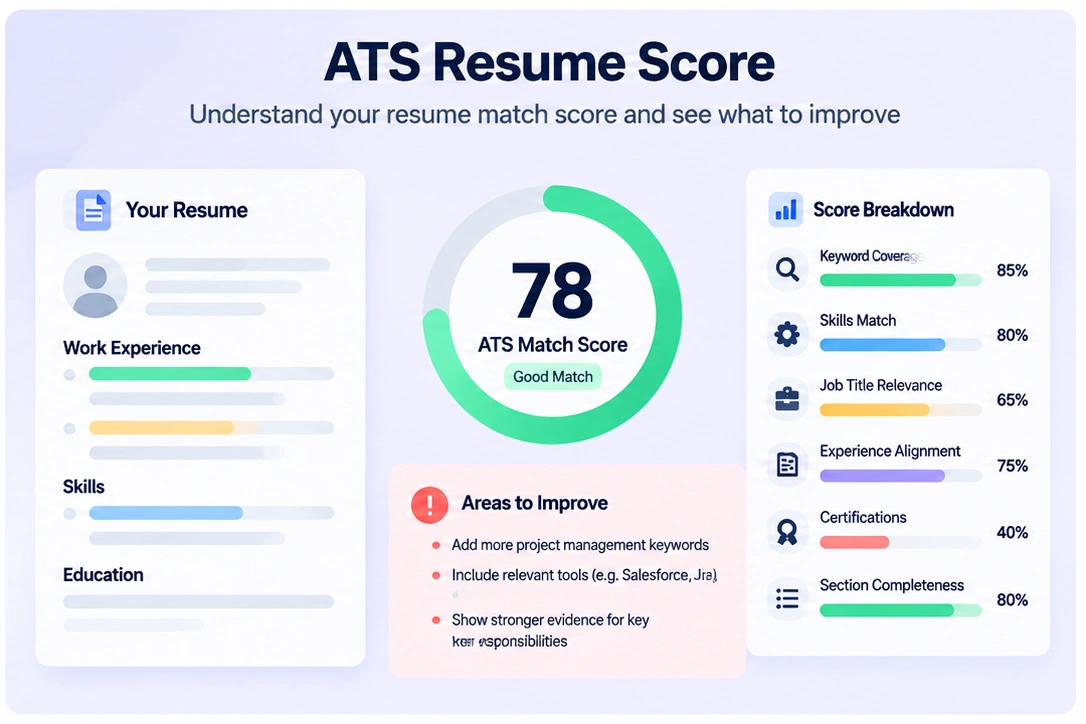
What Is an ATS Resume Score?
An ATS resume score generally refers to a numerical or structured assessment of how well a resume aligns with a particular job or set of resume criteria.
Depending on the tool, an analysis may consider keyword coverage, required skills, preferred qualifications, job-title relevance, certifications, experience alignment, job-description terminology, resume sections, and missing qualifications.
Different tools can evaluate these factors differently. That is why the explanation behind a score is more useful than the number alone.
There Is No Universal “Good ATS Score”
You may see advice claiming that a particular number is always a good ATS score.
“70 is good.”
This is not a universal hiring standard.
“80 means your resume will pass.”
No single threshold applies across employers and tools.
“90 guarantees strong ATS performance.”
A high tool score cannot guarantee how an employer will evaluate an application.
Employers use different hiring processes and technologies, and resume-analysis tools may calculate their own match scores using different methods.
What is causing the mismatch?
Not simply: Is this number high enough?
What Can Affect an ATS Resume Score?
Keyword Coverage
Does your resume clearly include important job-related terminology that accurately reflects your skills, tools, technologies, certifications, responsibilities, and industry experience?
If this is the main issue, a resume keyword checker can help examine that part of the match more closely.
Required Skills
If a job specifically requires a skill, your resume should make that skill easy to locate when you genuinely possess it.
Certifications and Licenses
Credentials such as CPA, RN, PMP, BLS, EPA 608, or CDL may matter significantly when the role requires them.
Experience Alignment
A resume can contain strong experience that is not especially relevant to the particular role. Alignment considers whether the emphasized experience supports the target job.
Job-Specific Responsibilities
“Helped with projects” is vague. “Coordinated project schedules, stakeholder requirements, and cross-functional delivery” provides clearer evidence.
Resume Sections
Depending on the analysis method, missing or unclear sections may affect how easily the resume can be evaluated.
Example of an ATS Match Review
Imagine a financial analyst job asks for SQL, Tableau, financial forecasting, variance analysis, and stakeholder communication.
Clearly Demonstrated
SQL, financial forecasting, and variance analysis are already supported in the resume.
Flagged for Review
Tableau and stakeholder communication are not clearly represented.
What to Investigate
The experience may be missing, described differently, or genuinely outside the candidate's background.
The useful part of the score is discovering which situation applies—not assuming that every flagged term belongs in the resume.
Focus on the Reasons Behind the Score
A number without an explanation gives you very little to work with. A useful ATS review should help answer:
- Which important skills appear to be missing?
- Which qualifications are already clear?
- Which requirements may be genuine gaps?
- Where does the resume use vague language?
- Which sections deserve revision?
- Which job-description terms accurately reflect existing experience?
These answers are more actionable than simply trying to raise a number.
Do Not Optimize for 100
A perfect-looking score is not the objective. Trying to insert every phrase from a job description can make a resume repetitive, unnatural, difficult to read, less credible, or misleading.
The goal is not: Make the score as high as possible.
The goal is: Make genuine qualifications and relevant experience as clear as possible.
ATS Resume Score vs. Keyword Matching
Keyword Matching
Focuses on terminology such as skills, tools, certifications, responsibilities, and job-specific terms.
Broader ATS Match Review
May also consider skills alignment, qualifications, experience relevance, resume sections, and job-description matching.
A keyword gap is only one possible reason behind a lower match.
ATS Resume Score vs. Job Description Matching
A resume job description matcher focuses on the relationship between your actual background and a specific target role.
- Does the resume clearly show the skills the role requires?
- Are important responsibilities supported by evidence?
- Are required credentials visible?
- Is the most relevant experience receiving enough emphasis?
An ATS score can summarize parts of that analysis, while job matching helps you understand the underlying reasons.
A Lower Score Can Reveal a Real Qualification Gap
Not every mismatch should be “fixed.” If a job requires an active CPA license and you do not hold one, adding accounting terminology will not change that fact.
Likewise, keyword optimization cannot legitimately create several years of professional Kubernetes experience for someone who has never used Kubernetes professionally.
Missing wording, buried experience, and genuine qualification gaps require different responses. Do not turn a genuine gap into an unsupported claim.
Do Different ATS Systems Use the Same Score?
No universal scoring system applies across every employer or applicant tracking system.
- Organizations configure systems differently.
- Hiring teams search for different qualifications.
- Recruiters review applications differently.
- Some processes use additional screening questions.
- Manual review may happen at different stages.
Treat a resume match score as a review tool rather than a prediction of an employer's hiring decision.
What Should You Do After Reviewing Your Score?
Read the Explanation
Identify which areas caused the weaker match instead of focusing only on the number.
Separate Wording Problems From Real Gaps
Ask whether the qualification exists but is unclear, or whether you genuinely lack it.
Improve Relevant Sections
Review the summary, skills, experience bullets, certifications, and education.
Add Evidence
A skill supported by a real accomplishment is stronger than a skill repeated several times.
Review the Resume Again
Compare the updated version against the same target job description.
Can a High ATS Score Guarantee an Interview?
No. A resume is only one part of an application and hiring process.
Employers may also consider experience, qualifications, location, work authorization, screening questions, portfolio or work samples, interviews, compensation, availability, and other candidates.
A match score should not be presented as a hiring probability.
What Is More Important Than the Number?
The most useful outcome is understanding what to change.
Number Without Context
“Your score is 64.” This does not explain what is weak or what should happen next.
Actionable Explanation
“The role requires Tableau, forecasting, SQL, and stakeholder reporting. Forecasting and SQL are clear, but Tableau is absent and stakeholder communication is vague.”
Use an ATS Score as a Diagnostic Tool
Strong Match
Your resume already provides clear evidence for an important requirement. You may not need to change anything.
Wording Gap
You have relevant experience, but the connection is unclear. Rewrite for clarity.
Missing Evidence
You mention a skill but provide little evidence that you used it. Strengthen the experience bullet if possible.
Genuine Qualification Gap
You do not possess the requirement. Do not invent it.
Check the Resume, Then Improve the Resume
Use the ATS Resume Checker to review how your resume aligns with the target job.
Once you know which areas deserve attention, the Resume Builder can help you present your genuine skills, experience, and accomplishments more clearly.
Frequently Asked Questions
What is an ATS resume score?
It generally refers to an assessment of how well a resume aligns with a job description or resume criteria such as keywords, skills, qualifications, and experience.
What is a good ATS resume score?
There is no universal good score across all employers, applicant tracking systems, or analysis tools. Use the score to understand alignment and potential gaps.
Is 80 a good ATS score?
A score of 80 may mean different things in different tools. No universal threshold guarantees that a resume will pass an employer's screening process.
Should I try to get a 100 ATS score?
No. Copying every keyword can make a resume less natural or misleading. Focus on accurately presenting genuine qualifications.
Can an ATS score guarantee an interview?
No. Hiring decisions involve many factors beyond resume matching, including qualifications, screening questions, interviews, location, and other candidates.
How can I improve my ATS resume score?
Review the reasons behind it. Clarify genuine relevant experience, add truthful missing skills or credentials, and strengthen evidence in experience bullets.